
Samsung Electronics has announced that it is set to launch its first trifold phone in the market. The company unveiled its first multi-folding smartphone on Tuesday, marking a significant move to strengthen its position in a segment where competition is expected to intensify.
The launch of the Galaxy Z Trifold represents Samsung’s attempt to reinforce its footing in a category where Chinese manufacturers have been rapidly gaining ground. However, analysts note that the high price and production challenges may mean foldable devices will likely remain a niche category for now.
Priced at about 3.59 million won, the Galaxy Z Trifold unfolds into a 253.1-millimetre (10-inch) display using three panels and is nearly 25% larger than Samsung’s latest foldable, the Galaxy Z Fold. The Galaxy Z Trifold showcases Samsung’s engineering mastery; the company has long led design and research in the foldable sector, driven by a deep understanding of how people use their devices.
Samsung’s decade-long experience in foldable innovation has inspired the Galaxy Z Trifold’s unique user experience. Measuring just 3.9 mm at its thinnest point, the device delivers flagship-level performance with the customised Snapdragon 8 Elite Mobile Platform, a 200 MP camera, and the largest battery Samsung has ever included in a foldable phone. Battery cells are placed across all three panels, and with 45 W super-fast charging, the Galaxy Z Trifold allows users to stream, create, and work without limits.
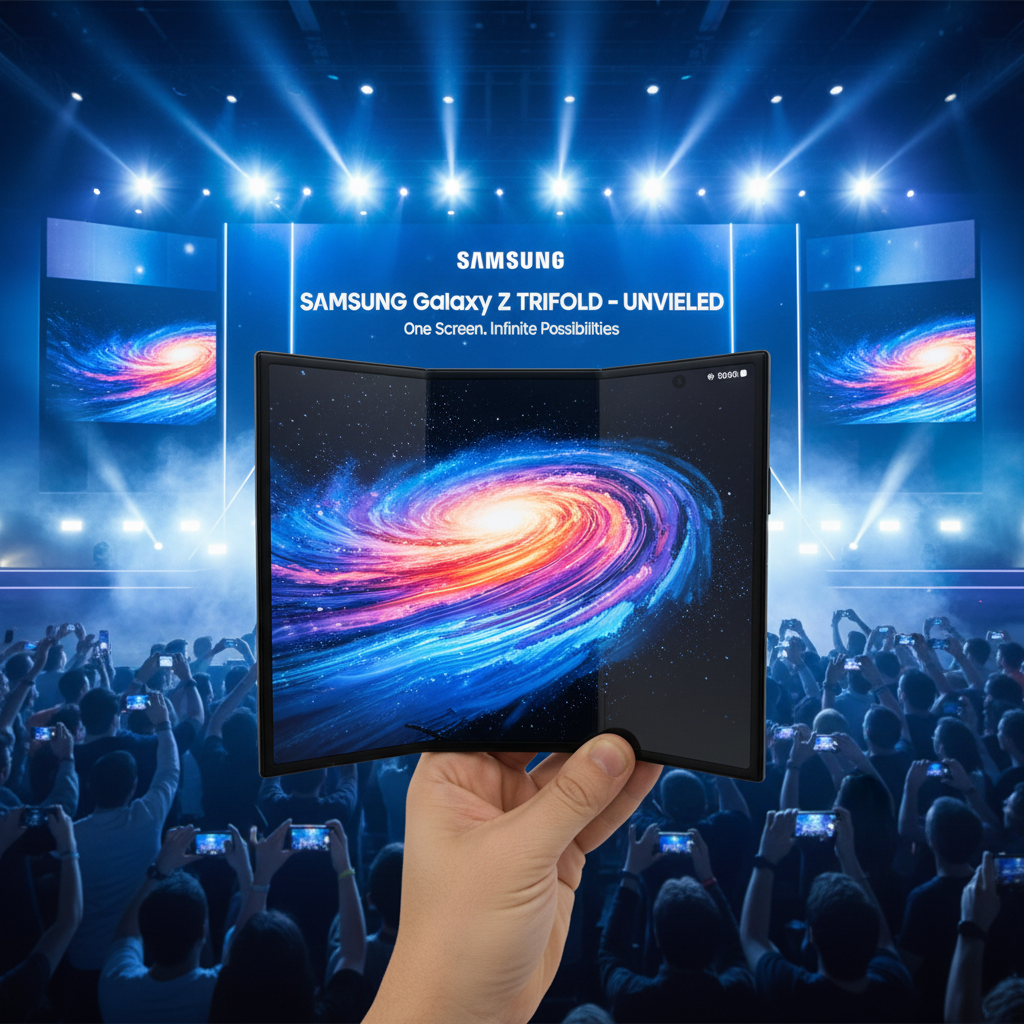
To balance power and portability, Samsung has introduced its most advanced hinge system yet. The refined Armor Flex Hinge is designed to meet the unique demands of a trifold device. Two differently sized hinges with a dual-rail structure work in harmony, creating a smoother, more flexible experience.
The Galaxy Z Trifold also features re-engineered display technology built specifically for a 10-inch screen that folds twice into a pocket-sized phone. A reinforced overcoat has been added to enhance durability.
On the exterior, the titanium hinge housing incorporates a thin metal layer that protects the folding mechanism and resists wear over time. The device’s frame is supported by advanced Armor Aluminium, a high-strength alloy that adds rigidity without increasing weight or bulk.
Every unit undergoes strict quality inspections to meet the highest standards. For example, CT scanning of the flexible printed circuit board verifies accurate manufacturing, while laser scanning ensures that all internal display components are mounted precisely at the intended height.